NAD+ Injections vs IV Drips: Which Is Right for You?
Published · 9 min read
Quick answer
NAD+ IV drips deliver a large dose in one clinic session but take hours, since studies show slow infusions are best tolerated. NAD injections under the skin take minutes at home, absorb gradually and suit a steady routine. For busy people, at-home subcutaneous shots under physician guidance are often more practical.
Key takeaways
- IV NAD+ was well tolerated at a slow rate of about 2 mg per minute over 6 hours in a pilot study.
- Faster IV infusions have been linked to cramping, nausea and chest pressure that stopped when the infusion ended.
- Subcutaneous NAD+ injections take minutes at home and are an area of emerging research.
- Breaking down NAD+ produces nicotinamide, which uses methyl groups, so TMG is often paired with NAD+.
- A physician should review your health history before you choose a format and dose.
In this article
- What is NAD+, in one minute?
- How do NAD+ formats compare?
- What does research show about NAD+ IV drips?
- What does research show about NAD+ subcutaneous injections?
- What is it like to give NAD injections at home?
- Are NAD+ shots better than IV?
- Why is TMG recommended with NAD+?
- Who should talk to a provider before starting NAD+?
- NAD+ injections with Rewinding
If you have decided to explore NAD+, the next question is format. NAD injections you give at home and IV drips at a clinic deliver the same molecule in very different ways, with real differences in time, comfort and convenience. This guide compares NAD IV vs injection, along with nasal sprays and oral precursors, so you can pick the format that fits your life.
What is NAD+, in one minute?
NAD+ (nicotinamide adenine dinucleotide) is a coenzyme every cell uses to turn food into energy and to power maintenance enzymes. A major review in Nature Reviews Molecular Cell Biology describes NAD+ as central to energy metabolism and a required partner for enzymes such as sirtuins and PARPs, and notes that tissue NAD+ levels gradually decline with age in rodents and humans.
That is the short version. For the full picture of what NAD+ does and why people use it, read What Is NAD+ Therapy?
How do NAD+ formats compare?
The main options are an IV drip, a subcutaneous injection at home, an intramuscular shot, a nasal spray and oral precursors. They differ most in session time, where you take them, and how much human research exists for each.
| Format | Time per session | Where it happens | Convenience | What research exists |
|---|---|---|---|---|
| IV drip | About 1.5 to 6 hours in published studies | Clinic or infusion center | Requires an appointment and a chair for hours | Small human studies on how the body processes it and how well it is tolerated |
| Subcutaneous injection | A few minutes | At home | Fits into a daily routine; no travel | Emerging research; injectable NAD+ precursors are now in human trials |
| Intramuscular injection | A few minutes | Usually a clinic | Quick, but a deeper injection into muscle | Emerging research, mostly on injectable precursors |
| Nasal spray | Seconds | At home | Very easy to use | Early, mainly animal studies |
| Oral precursors (NR, NMN, niacin) | Seconds | At home | Easiest; a capsule or powder | Several human trials showing blood NAD+ rises |
A quick way to read the table: the formats on top deliver NAD+ itself directly into the body, while oral options give your cells building blocks that they turn into NAD+. Session time and setting tend to matter most in daily life, because the best format is the one you can stick with consistently.
What does research show about NAD+ IV drips?
Studies show IV NAD+ is well tolerated when it is infused slowly, and that a faster pace is linked to uncomfortable symptoms. That makes the drip rate, not just the dose, the key variable.
In a 2019 pilot study in Frontiers in Aging Neuroscience, healthy men received 750 mg of NAD+ over 6 hours, a rate of about 2 mg per minute. The researchers reported no adverse events during the infusion. Interestingly, blood NAD+ did not rise until after the 2-hour mark, and by the end of the infusion it had climbed to roughly four times baseline. The team suggested the body clears NAD+ from the blood quickly at first, likely as tissues take it up and enzymes break it down.
A 2026 real-world study in Frontiers in Aging looked at the other end of the speed range. Clients at a wellness clinic received 500 mg of NAD+ by IV on four consecutive days and controlled their own drip rate, averaging about 97 minutes per session. At that faster pace, every NAD+ client reported symptoms such as abdominal cramping, nausea, a faster heart rate or chest pressure. The symptoms led clients to slow their infusions and stopped as soon as each infusion ended. Liver enzymes and inflammation markers showed no clinically significant changes over 30 days.
The practical takeaway: an IV drip can deliver a large dose in one sitting, but doing it comfortably means a long, slow session at a clinic. For a weekly or monthly schedule, that adds up to travel, waiting room time and several hours in a chair, which is the main reason many people look for an alternative.
What does research show about NAD+ subcutaneous injections?
NAD+ subcutaneous injection is an area of emerging research. Published human studies of injected NAD+ itself are still limited, but the field is moving quickly, and researchers are now running formal trials of injectable NAD+ precursors under the skin and into muscle.
One example is a registered pilot study of injectable nicotinamide riboside (NR), a direct NAD+ precursor. It compares subcutaneous and intramuscular doses in 40 healthy adults, starting with in-clinic injections and moving to at-home self-injection three times a week for about 100 days. It tracks safety, tolerability and whole-blood NAD+ levels, along with energy, fatigue and sleep as exploratory outcomes. Studies like this are building the evidence base for the at-home injection model.
Why do so many people choose subcutaneous NAD+? A subcutaneous injection places the dose into the fatty layer just under the skin, where it absorbs more slowly than through a vein or muscle. Given the IV findings above, a gradual entry is a reasonable fit for a molecule that is better tolerated at a slower pace. It also turns a multi-hour clinic visit into a few minutes at home, and smaller, regular doses can fit around work, travel and family instead of the other way around. Your physician decides how much and how often, and can fine-tune the plan as you go.
What is it like to give NAD injections at home?
For most people, an NAD injection at home is a short, routine step once they have been shown how. You use a small needle in a fatty area of the body, and your physician sets your dose and schedule.
Patient guidance on subcutaneous injections recommends these basics:
- Pick a fatty area you can pinch, such as the lower abdomen (staying about 2 inches from the belly button), the back or side of the upper arm, or the front of the thigh.
- Rotate sites each time, and skip spots that are red or hard.
- Expect occasional minor bruising or redness at the site.
- Dispose of needles safely right away in a puncture-resistant sharps container.
In industry-reported pilot data on injectable NR, side effects were generally mild and short-lived, with localized injection-site discomfort, redness or sensitivity among the most common. If a reaction is bigger than expected or does not settle, contact your provider. Your physician can also adjust your dose or timing if you notice any flushing or stomach upset.
Are NAD+ shots better than IV?
Neither format is better for everyone; the right choice depends on your priorities. IV drips suit people who want a large dose in one supervised session, while NAD+ shots suit people who value convenience and a steady routine.
- Choose IV if you prefer clinic supervision, are comfortable with a long session, and live near a provider.
- Choose subcutaneous injections if you want a few-minute routine at home, no travel, and smaller doses spread over time.
- Consider oral precursors if you are not ready for needles. A randomized crossover trial in 30 healthy middle-aged and older adults found that NR was well tolerated and raised NAD+ levels. Compare options in NR vs NMN vs Niacin.
Nasal NAD+ is the newest format. In a rat study, intranasal NAD+ raised NAD+ levels in the brain, but human data are still early.
Why is TMG recommended with NAD+?
When your body breaks down NAD+, it produces nicotinamide, and clearing nicotinamide uses methyl groups. TMG (trimethylglycine, also called betaine) is one of the body's main methyl donors, which is why it often comes up alongside NAD+.
The enzyme that processes nicotinamide, NNMT, uses SAM, the body's universal methyl donor, to convert it into methylnicotinamide, which is then excreted. You can see this pathway at work in the IV study above: methylnicotinamide rose about 350% in the blood by the end of the NAD+ infusion.
A randomized study in 30 adults adds a direct link to TMG. Three hours after a single 300 mg dose of nicotinamide, plasma betaine was about 24% lower than in the control group and homocysteine was higher. The authors concluded that breaking down nicotinamide consumes betaine. That is why Rewinding recommends taking NAD+ with Rewind Time or, at minimum, a reliable TMG supplement, to help support your methyl supply.
Who should talk to a provider before starting NAD+?
Everyone should start NAD+ under a physician's guidance, and some people need a closer review. Your physician looks at your health history, medications and goals before recommending a format and dose.
Be sure to mention it if you:
- Are pregnant, planning a pregnancy or breastfeeding.
- Have a heart condition, since faster IV infusions have been linked to a faster heart rate and chest pressure.
- Have liver or kidney concerns, or take several prescription medications.
- Have a history of fainting with needles, or a bleeding disorder or blood thinner use that makes bruising more likely.
- Are being treated for cancer or another serious illness.
Rewinding's health content follows our editorial policy, and you can learn how we vet partners and pharmacies on our trust page.
NAD+ injections with Rewinding
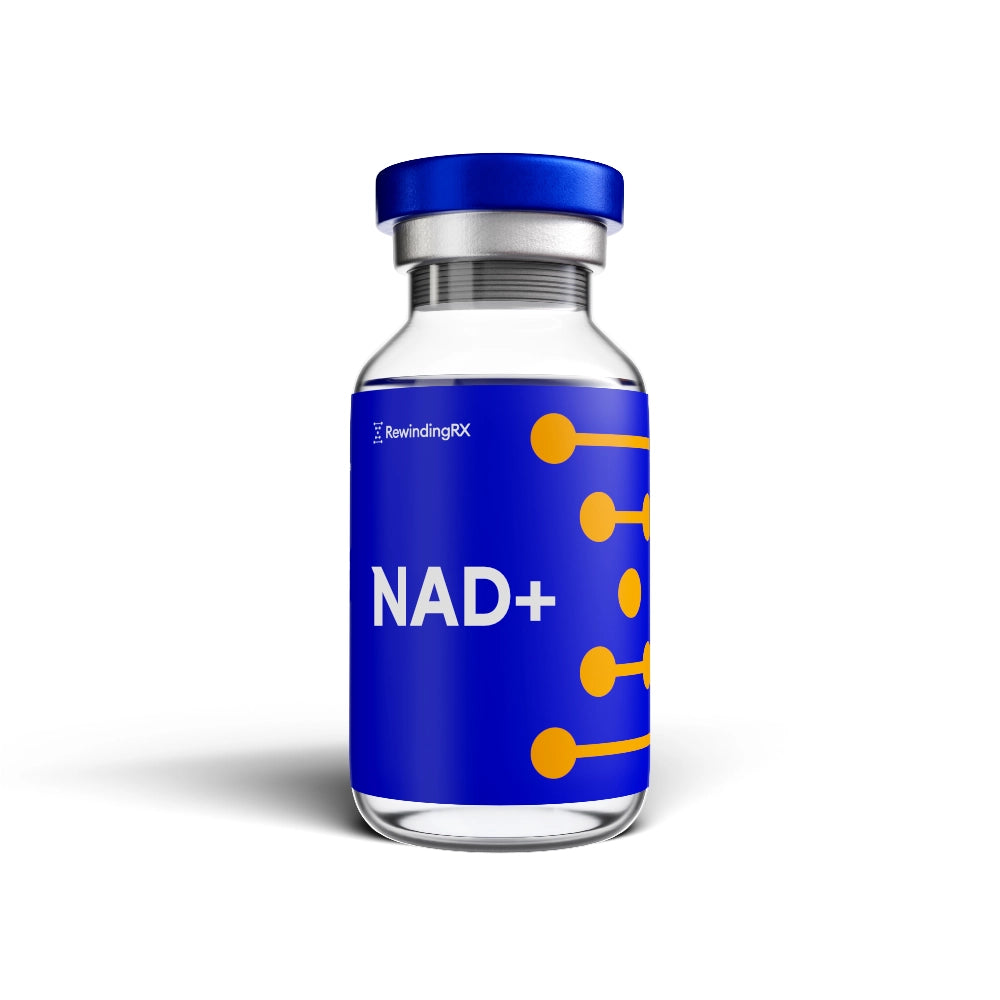
Rewinding's NAD+ program is built around at-home subcutaneous injections, with physician oversight from start to finish.
- Complete an online consultation about your health history and goals.
- An independent licensed U.S. physician reviews it, typically within 24 to 48 hours.
- If appropriate, your NAD+ is prepared by a licensed U.S. 503A compounding pharmacy.
- It ships free by express with syringes and alcohol prep pads, plus ongoing physician support. Pause or cancel anytime.
Ready to see if it fits you? Start with Rewind NAD+.
Frequently asked questions
Do NAD+ injections hurt?
Most people feel only a quick pinch, since subcutaneous injections use a small needle in fatty tissue. Mild redness, sensitivity or bruising at the site can happen and usually settles on its own.
How long does an NAD+ IV take compared with an injection?
Published IV studies ran from about 1.5 to 6 hours per session, with slower drips better tolerated. A subcutaneous injection at home takes a few minutes.
Can I do NAD injections at home?
Yes, subcutaneous NAD+ is designed for at-home use once a physician has prescribed it and you have learned the technique. Rotate injection sites and use a sharps container for needles.
Where do you inject NAD+ subcutaneously?
Common sites are the lower abdomen, the back or side of the upper arm, and the front of the thigh. Changing the site each time helps keep the skin comfortable.
Should I take TMG with NAD+?
Clearing nicotinamide, a breakdown product of NAD+, uses methyl groups, and a human study found nicotinamide lowered betaine (TMG) levels. Rewinding recommends Rewind Time or a reliable TMG supplement alongside NAD+.
Are oral NAD+ supplements an alternative to shots?
Oral precursors like nicotinamide riboside have been shown in human trials to raise blood NAD+ levels. They work differently from injected NAD+, so ask your provider which approach fits your goals.
Sources
- Grant R, et al. (2019). A Pilot Study Investigating Changes in the Human Plasma and Urine NAD+ Metabolome During a 6 Hour Intravenous Infusion of NAD+. Frontiers in Aging Neuroscience.
- Reyna K, et al. (2026). Intravenous infusion of nicotinamide adenine dinucleotide (NAD+) versus nicotinamide riboside (NR): a retrospective tolerability pilot study in a real-world setting. Frontiers in Aging.
- Covarrubias AJ, et al. (2021). NAD+ metabolism and its roles in cellular processes during ageing. Nature Reviews Molecular Cell Biology.
- Martens CR, et al. (2018). Chronic nicotinamide riboside supplementation is well-tolerated and elevates NAD+ in healthy middle-aged and older adults. Nature Communications.
- Sun W, et al. (2017). Comparison of the effects of nicotinic acid and nicotinamide degradation on plasma betaine and choline levels. Clinical Nutrition.
- Li XY, et al. (2022). Nicotinamide N-Methyltransferase: A Promising Biomarker and Target for Human Cancer Therapy. Frontiers in Oncology.
- Ying W, et al. (2007). Intranasal administration with NAD+ profoundly decreases brain injury in a rat model of transient focal ischemia. Frontiers in Bioscience.
- ChromaDex, Inc. (2025). Randomized, Open-label, Safety Study of Subcutaneous and Intramuscular Injections of Niagen Plus (NCT07251608). ClinicalTrials.gov listing via CenterWatch.
- Manufacturer white paper (2026). Niagen Plus: Current Evidence and Clinical Outcomes, August 2026.
- OncoLink (n.d.). How To Give a Subcutaneous (SubQ or SQ) Injection. OncoLink.
This article is for general information only and isn't medical advice. Talk to a licensed healthcare provider before starting, stopping or changing any treatment. Compounded medications are prepared by licensed pharmacies and are not FDA-approved. How we write and check our articles.
Talk to a licensed provider
Answer a few questions online and a provider will review whether a treatment is right for you.
Explore treatments